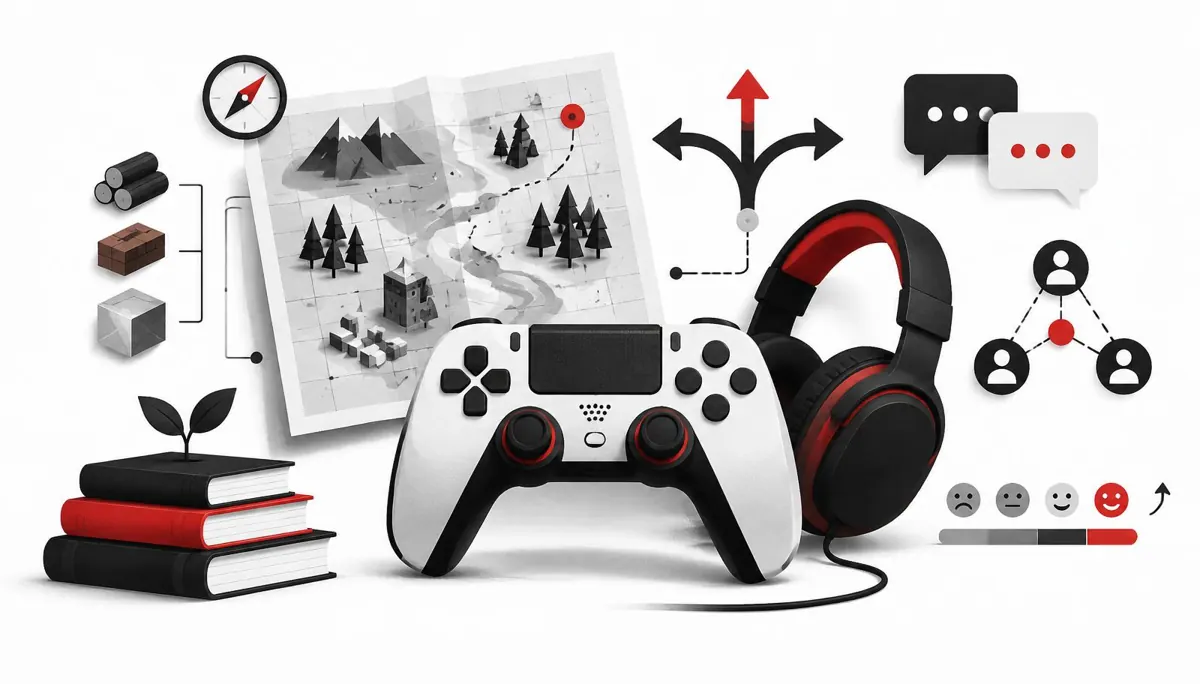
I know some parents might find it strange to hear that I let my 8-year-old son play Fortnite. Yes, we allow it at home, but under very specific conditions: with supervision, time limits, clear rules, parental controls, and, often, with me sitting beside him or even playing along.
I don't do it because I think a video game replaces other important childhood experiences, or because I believe all digital content is automatically educational. I'm not trying to tell other parents what they should allow in their homes, either. Every child is different, and every family has to make its own decisions based on their child's age, maturity, and circumstances. In our case, as a dad who's been playing video games his whole life and also works with technology every day, I try to look a little beyond the screen and understand what's happening while he plays.
And what I see isn't just entertainment. I see decision-making, planning, communication, coordination, resource management, technology, social interaction, and, above all, countless opportunities to talk with my son about how to behave in a digital space.
First, an important clarification
Fortnite Battle Royale is rated T for Teen by the ESRB because of elements such as violence, song lyrics, and other content. That rating exists, and I think it's important to acknowledge it. That's exactly why letting my son play doesn't mean giving him unrestricted access to everything on the platform or leaving him alone with it.
Fortnite is now also a platform with multiple experiences, and Epic Games offers parental controls to restrict content by rating, manage purchases, and limit communication. For children under 10, for example, Epic sets “Friends Only” as the most permissive setting allowed for voice and text chat. In our case, knowing who he plays with, controlling social features, and keeping an eye on what happens in the game are all part of the experience.
To me, that distinction is essential. This article isn't about claiming that Fortnite is appropriate for every 8-year-old. It's about explaining why, within our family and under our supervision, I've found positive things in the experience of playing it with my son.
There's a lot more thinking behind a match than you might expect
When an adult who doesn't play watches Fortnite from the outside, it might look like nothing more than a child running around a screen and shooting at other characters. When I spend some time watching my son play, the experience becomes much more complex. He has to decide where to land, what items he needs, which resources to save, what route to take, where his teammates are, how much time is left before the play area changes, when it makes sense to take on another team, and when it's better to avoid a fight he probably can't win.
All of that happens pretty quickly. The player is taking in visual and auditory information, filtering some of it out, paying attention to other parts, updating decisions, and constantly reacting to changing situations. In cognitive psychology, processes such as working memory, impulse control, attention, and planning are part of what we call executive functions.
There's interesting research in this area, though it needs to be interpreted correctly. A study based on data from the Adolescent Brain Cognitive Development project, supported by the US National Institutes of Health, analyzed nearly 2,000 children ages 9 and 10. Researchers found that those who reported playing video games for three or more hours a day performed better on certain tests of impulse control and working memory than those who said they didn't play video games.
That doesn't mean playing more hours is better, or that video games caused those differences. The researchers themselves emphasize that the study was observational and cannot establish cause and effect. To me, the interesting part is much simpler: it helps challenge the idea that the brain is necessarily “switched off” during a video game. Depending on the game and how it's used, some pretty intense cognitive activity may be taking place.
Planning, strategy, and learning to change the plan
One of the things that stands out to me most is the planning. Fortnite constantly pushes you to think about what to do now while anticipating what might happen next. You have to watch the map, consider your team's position, manage resources, and adjust your strategy as circumstances change. The plan that seemed perfect thirty seconds ago might stop working because another team showed up, the safe zone changed, or a teammate needs help.
That process of making a plan, carrying it out, discovering it didn't work, and changing it seems valuable to me. Not because I think a Fortnite match is the equivalent of a strategy class, but because it creates a space where decisions have immediate consequences. If a strategy goes wrong, another match begins, bringing another chance to try something different.
As a parent, I also see an opportunity for conversation there. Instead of focusing only on the fact that he lost, we can talk about why he lost, what decision he made, what he could have done differently, and what he learned from that match. That small shift turns frustration into analysis.
Solving problems without Dad giving him the answer
Video games have a quality I really like: they constantly present problems, but they usually don't stop the experience to hand you the solution right away. The player has to experiment. If he runs out of certain resources, he has to adapt. If the team ends up in a bad position, he has to find a way out. If one strategy stops working, it's time to improvise another.
In that sense, I like watching my son try to figure things out before asking me for help. Sometimes he finds a solution I wouldn't have considered myself. Other times he gets it completely wrong. But that's exactly where some of the learning I care about happens: understanding that making a mistake doesn't mean it's all over.
Video games let you repeat that cycle very quickly: attempt, result, adjustment, and another attempt. In its guidance for parents on video games, UNICEF specifically notes that games can present challenges where children try, fail, and try again. To me, the important part isn't turning every match into a formal lesson, but allowing that practice of sticking with something to happen in a controlled environment.
Teamwork and real communication
This is probably one of the things I most enjoy watching. Fortnite can be played solo, but when my son plays with friends or family, the experience changes completely. Suddenly, he has to listen to other people, communicate information quickly, decide where to move, share resources, and understand that he can't always do whatever he wants if the team is trying to carry out a different plan.
Over time, I've even seen him get better at explaining things. Just saying “He's over there!” doesn't help much when three other people need to understand where “there” is. He has to learn to say whether something is to the right or left, in front or behind, or near a specific point on the map. He has to communicate quickly, but also in a way other people can understand.
And he has to listen, too. If a teammate needs help, he can't always keep doing what he was doing. If someone else has a better position or better information, sometimes it's his turn to follow their lead. These are simple situations within a video game, but they involve practicing coordination, taking turns leading, listening, and cooperating.
There's even research specifically involving Fortnite. A study published in Computers in Human Behavior with children ages 9 to 12 found that those who played cooperatively later showed more prosocial behaviors in the researchers' tasks than those who played alone. That doesn't mean Fortnite automatically makes a child more cooperative. What it does suggest is something I find very interesting: how you play matters. The social and cooperative context can be just as relevant as the game's content.
Learning to win, lose, and handle frustration
Fortnite also offers plenty of opportunities to lose. Plenty. You can do almost everything right during a match and lose in the final seconds because of one bad decision. For a child, that frustration is real, even if adults might see it as insignificant.
That's another reason I prefer to stay close. I'm not just interested in monitoring what appears on the screen. I can also see how he reacts. If he gets too upset, we can stop. If he immediately blames a teammate, we can talk about responsibility. If he wants to quit because he's lost several matches in a row, we can talk about the difference between feeling frustrated and giving up.
I don't think a video game teaches emotional regulation on its own. That develops when a child has opportunities to experience emotions and adults who help him understand and manage them. In that sense, a match that ends badly can become a small opportunity to learn to breathe, think things through, accept a loss, and decide whether it's worth trying again.
Making decisions about resources and priorities
Within a match, everything is limited. There's ammunition, items, inventory space, time, and opportunities. You can't carry everything or be everywhere at once. You constantly have to choose what to keep and what to leave behind.
I'm not going to say Fortnite is an economics class, because it isn't. But I do find it interesting to watch a child assess resources and set priorities in real time. Do I need this now, or might I need that later? Should I use this resource or save it? Do I need it, or would it be more useful to give it to a teammate?
They're small decisions within a game, but they're part of a much more active experience than we often imagine when we talk generally about “screen time.” To me, not every screen represents exactly the same activity. Passively watching a video for an hour isn't the same as spending that hour in an interactive experience that requires decisions, communication, and constant responses.
Technology stops feeling unfamiliar
There's also a digital literacy component that I personally value a lot. My son is growing up in a world where interacting with interfaces, accounts, updates, settings, connections, privacy, and digital platforms will be part of everyday life. As he plays, concepts involving servers, latency, updates, devices, controllers, audio, accounts, and security come up.
That doesn't mean knowing how to play a video game makes anyone a technology expert. But it does help make the digital environment feel familiar, and it sparks questions. At home, those questions often lead to much broader conversations about the internet, privacy, passwords, strangers online, digital purchases, and why certain settings exist.
For me, having spent practically my entire professional life working in digital advertising, websites, and technology, that literacy has value. I'd rather be there as he starts navigating that world and gradually teach him how it works than pretend it doesn't exist until he's older.
English comes into play because he needs to understand it
Here in Puerto Rico, there's another interesting reality. So much of the language surrounding video games is in English. Item names, commands, how-to videos, menus, and conversations about the game continually expose children to words and expressions in that language.
I don't think playing Fortnite replaces an English class or automatically teaches another language. What I do notice is something that happens with many kinds of learning: when someone needs to understand a word for an immediate purpose, they're more motivated to find out what it means. Suddenly, he's not memorizing vocabulary because someone assigned it. He wants to understand something because he needs it to do what interests him.
At home, I find it interesting to hear him switch naturally between Spanish and English while he plays. He asks what a word means, learns a new term, and then uses it again in the right context. That repeated exposure to a second language strikes me as another potential benefit of a digital experience with thoughtful adult involvement.
There's also research on video games specifically designed with action mechanics and cognitive training that has found improvements in certain reading and attention skills. Those studies shouldn't be applied directly to Fortnite, because they involve different games and experimental designs, but they do show that the relationship between video games, attention, and learning is much more interesting than simply assuming that playing always means wasting time.
The benefit that matters most to me: sharing his world
For me, the biggest benefit probably isn't even cognitive. It's about our relationship. When I play with my son, I spend a little time in something he's passionate about. Often, he's the one explaining things to me, teaching me a strategy, or telling me what changed after an update. And that role reversal, where the child gets to be the expert and the parent the learner, creates conversations that probably wouldn't happen otherwise.
UNICEF specifically recommends that parents sit down and play with their children, letting them show the adults their world. The idea isn't that adults have to become gamers. It's that taking a genuine interest in an activity your child enjoys opens the door to better conversations about how much to play, who to play with, what content is appropriate, and what risks exist.
That's exactly what I'm trying to do. I want my son to know that I don't need to put down something he likes in order to set limits. I can understand why he likes it, enjoy it with him, and, at the same time, tell him it's time to turn it off.
We have limits in our house, too
None of this means unlimited access. At home, video games coexist with school, reading, family, sports, off-screen activities, responsibilities, and rest. There are times to play and times when it's simply not time for that. The goal isn't to measure an activity's value only by how many minutes it takes up, but to keep it from crowding out other things that matter for his development and our family life.
Supervision isn't just about being physically nearby, either. It means knowing what he plays, who he talks to, how parental controls are set up, and what's happening with purchases. In our case, communication is restricted, we know the people he plays with, and digital purchases require an adult's involvement. V-Bucks don't magically appear at the push of a button.
And one particularly useful rule is to play together every now and then. It's hard to truly supervise a digital space you've never tried to understand. When a parent knows the game, it's easier to recognize both the positives and the things that need attention.
Moderation means looking at the whole child
I also prefer not to reduce this entire conversation to finding a magic number of minutes that works for every family. Time matters, but so does what he's playing, with whom, at what time of day, how he's sleeping, whether he's physically active, whether he's keeping up with his responsibilities, and how he reacts when it's time to turn off the screen.
The NIH research I mentioned earlier is a good example of why we need to avoid simplistic conclusions. In the same group that performed better on certain cognitive tests, researchers also observed higher scores on measures related to attention problems and some mental health symptoms, though they didn't reach clinical levels. The researchers were very clear that their findings don't mean children should play for unlimited amounts of time, and that different types of video games likely produce different experiences.
That's why my conclusion isn't “video games are good” or “Fortnite develops the brain.” My conclusion is much simpler: video games are a complex activity. They can offer opportunities to think, collaborate, solve problems, spend time with friends, learn about technology, and have fun, but their value depends enormously on how they fit into a child's life.
What I'm really trying to teach him
Letting my son play Fortnite doesn't mean I think he needs Fortnite to develop. It means I recognize that the digital world is already part of his generation's life, and I'd rather be there with him as he learns to navigate it.
While he plays, I see opportunities to practice planning, communication, coordination, and problem-solving. I see moments to talk about frustration, behavior, privacy, purchases, strangers on the internet, and respect for other players. I also see something much simpler: a child having fun with his friends and a dad who, some nights, gets the chance to step into that world and share it with him.
Then we turn off the console. There are bike rides, family, school, conversations, off-screen games, and plenty of other things to do. To me, that's exactly the point: not choosing between a “real” childhood and a digital one, but teaching him to live both with balance.
My responsibility as a parent isn't to convince myself that all technology is good or assume that every screen is bad. It's to know my son, set limits, understand the digital spaces he uses, and be there as he learns to make better decisions both in and out of them.
Because in the end, the video game is only one part of the experience. What matters most is still who's there with the child as he learns to play, to lose, to win, and, little by little, to navigate the digital world he's growing up in.
References and related reading
National Institutes of Health (NIH). “Video gaming may be associated with better cognitive performance in children” (2022, updated in 2023). The NIH summarizes the findings and limitations of the ABCD project study on video games, working memory, and impulse control. Read the article.
Chaarani, B. et al. “Association of Video Gaming With Cognitive Performance Among Children”. JAMA Network Open (2022). Research based on data from 9- and 10-year-old children in the ABCD study. Read the study.
Shoshani, A. & Krauskopf, M. “The Fortnite social paradox: The effects of violent-cooperative multi-player video games on children's basic psychological needs and prosocial behavior”. Computers in Human Behavior, Vol. 116 (2021). Among other aspects, the study examined differences between playing Fortnite cooperatively and playing individually. Read the study.
UNICEF. “Video games in childhood and adolescence: a guide for parents”. Includes recommendations on parental involvement, playing together, risks, social interaction, balance, and using parental controls. Read the guide.
Pasqualotto, A. et al. “Enhancing reading skills through a video game mixing action mechanics and cognitive training”. Nature Human Behaviour, Vol. 6 (2022). The study evaluated a video game specifically designed to combine action mechanics with cognitive function training. Read the study.
Entertainment Software Rating Board (ESRB). Official rating for Fortnite Battle Royale: T for Teen, with information about content, user interaction, and in-game purchases. View the rating.
Epic Games. Official information on parental controls for Fortnite and other Epic experiences, including communication permissions, purchases, content ratings, and restrictions for children's accounts. View parental controls.
Keep reading: how gaming culture became a marketing powerhouse and Three kids: millionaires in love.