Sometime in 1991, when I was nine years old, I grabbed a sheet of paper and drew a car of the future. It was low-slung, pointy, and exaggerated, with several rockets underneath and a huge one on the back spitting flames. That car was not designed to go faster than others. In the mind of that kid from Caguas, that car took off. I probably labeled it something like Future Car 2000, because for a child of the early nineties, the year 2000 was not just any number on the calendar. It was, quite simply, the future.
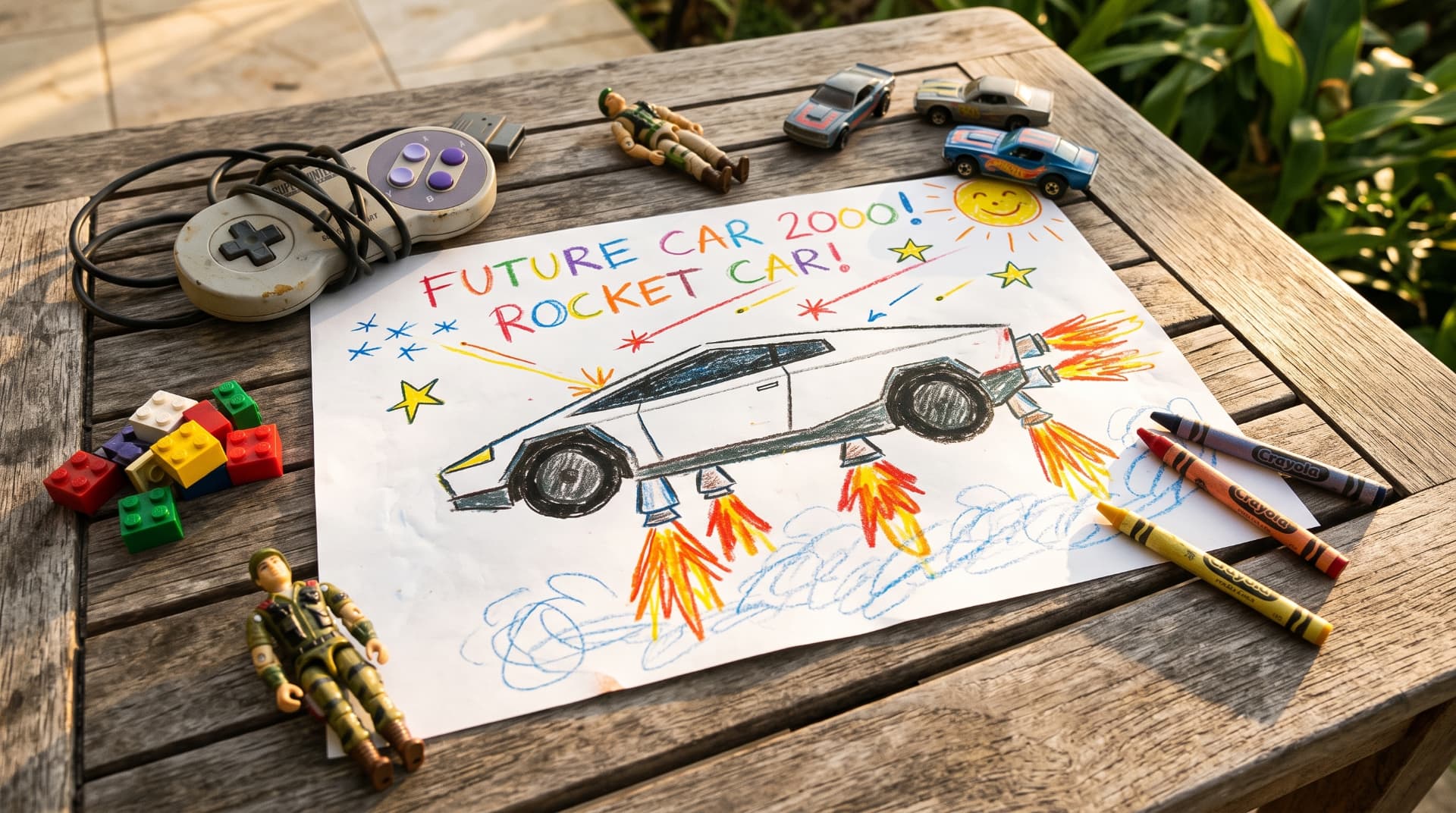
In that future, cars would fly, robots would help us around the house, and computers would be intelligent. Nearly all these ideas came to us from cartoons, movies, video games, toys, and magazines, and there was no clear boundary between technology, imagination, and science fiction. Today I am 44 years old with three children, and I feel an exceedingly strange sensation whenever I see images of the new Tesla Roadster lifting off the ground with thrusters. In an almost absurd way, the car I drew at age nine exists. It is not exactly the same, of course, but it is similar enough to leave me speechless.
The Roadster That, According to Tesla, Can Fly
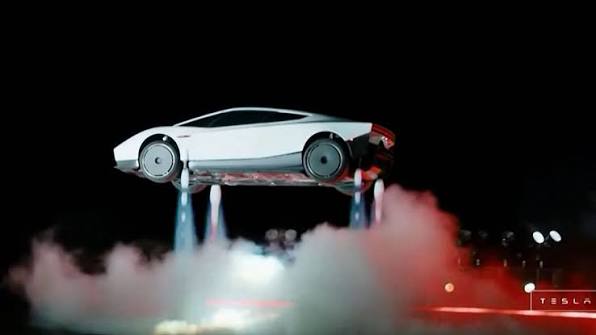
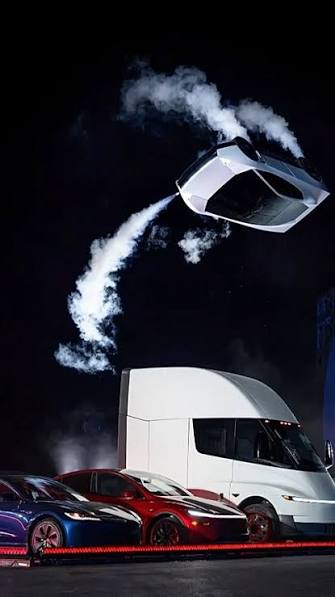
Tesla unveiled a version of the Roadster that uses technology developed with SpaceX: cold gas thrusters that assist acceleration, stabilize the vehicle, and allow it to take off for brief moments. The company itself describes the rocket-equipped version as a limited-availability model that is not approved for public roads, and on its website, summarizes this with an almost childlike phrase: yes, it can fly (Tesla). The October 2026 demonstration included mid-air maneuvers, a suction system to generate downforce, and acceleration from 0 to 60 miles per hour in under one second. Tesla plans to begin production in 2028, after years of delays since this generation was introduced in 2017 (Reuters).
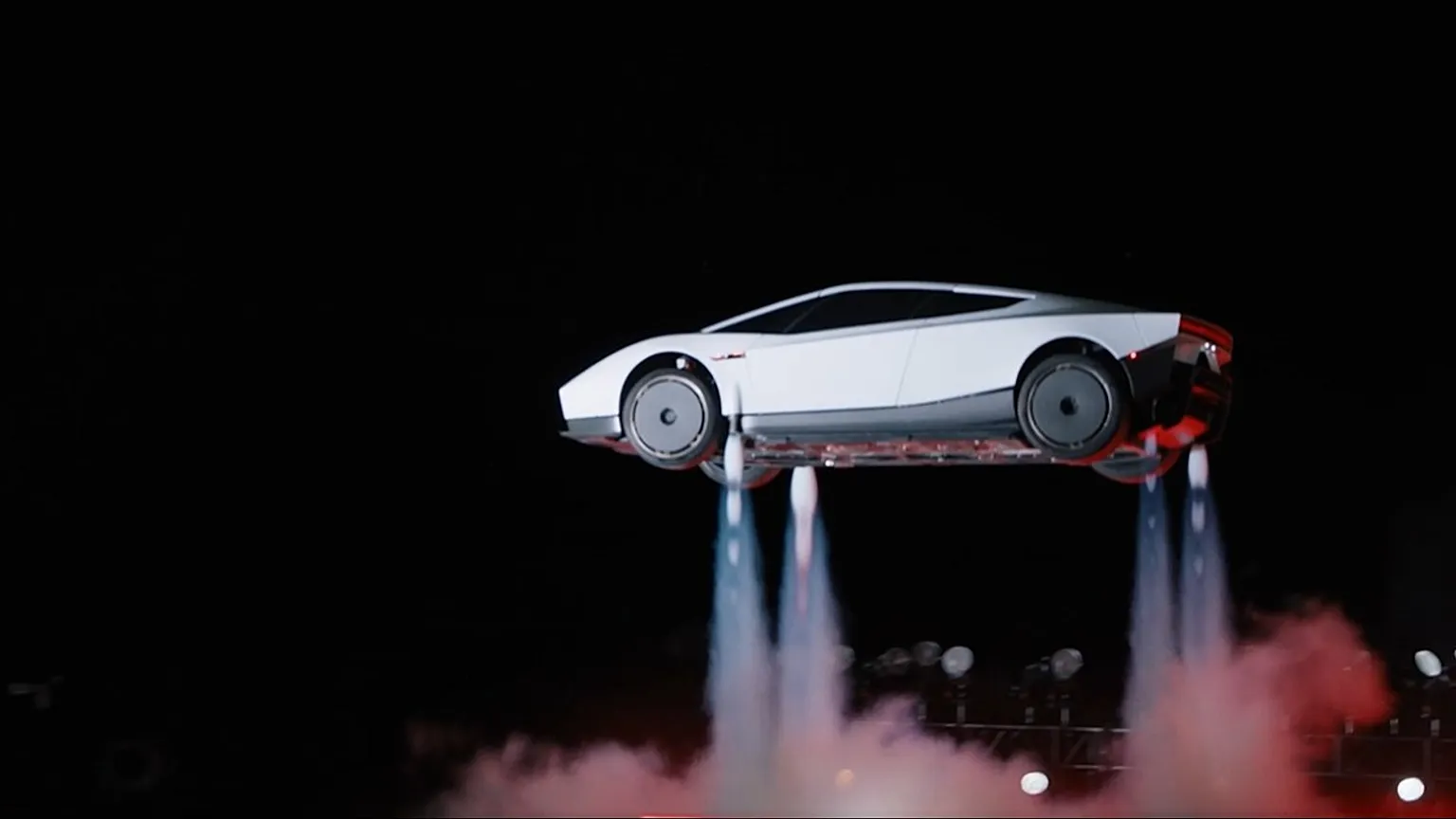
I know there is a great deal of spectacle in all this, and that a long road usually lies between a demonstration and a product on the street. But the sociological value of this scene does not lie in its technical specifications. It lies in what it awakens. When an object that until yesterday belonged to the realm of children's drawings appears at a corporate event, the line separating the imagined from the possible is momentarily broken. And this rupture affects us differently depending on the generation to which we belong.
Nostalgia and Realistic Futurism at the Same Time
My children play with LEGOs, watch Sonic, play Mario on a Nintendo, get excited about Spider-Man, and recognize the Ninja Turtles. Much of the culture that occupied my imagination when I was eight, nine, or ten years old is still alive in theirs. Sometimes I walk into a toy store and feel that an error has occurred somewhere in the space-time continuum, because my children can get excited about the same things that excited me in the early nineties. I wrote about this connection in how gaming culture became a marketing powerhouse, and I see it more clearly every day in my own home.
At the same time, these same children are growing up in a world that would have been incomprehensible to me at their age. They talk with an artificial intelligence, ask it to create an image, watch rockets land vertically after returning from space, and ride in electric cars that update themselves while they sleep. Sociologically, we are living in two eras at once. Culture relentlessly recycles the symbols of our childhood, because nostalgia sells and provides security in times of change, while technology accelerates toward territories that this same childhood considered science fiction. Perhaps that is why the Roadster provoked a much more emotional reaction in me than a car I will probably never buy should. I was not looking at a machine. I was looking at an idea that had survived for more than three decades within my imagination.
I Have Always Wanted to Be First to Enter the Future
Perhaps this is why I have never been afraid of technology. When the Internet began to enter our lives, I dove in headfirst as a teenager because I wanted to understand it. I told this story in the day I connected to the Internet. Then came search engines, blogs, social networks, digital advertising, smartphones, and data, and much of my professional life as a young adult was built precisely around that transition. As I explain in I’m not a programmer, but I’ve spent most of my life learning how the Internet works, I was never content to simply watch from the sidelines.
Now, the exact same thing is happening with artificial intelligence. I am not observing from a corner. I am on the inside, testing, building, making mistakes, automating, and connecting systems to understand what is extraordinary, what is exaggerated, and what can truly change the way we work. I am clearly pro-AI. Not because I believe everything it brings is positive, but precisely because I am so involved that I clearly see the coming debates on employment, education, privacy, concentration of power, intellectual property, and inequality, topics I explored in AGI: when artificial intelligence is no longer just a tool. Still, I cannot feign indifference. It fascinates me for the same reason I drew rocket cars at age nine. I want to know what comes next.
And Then There Is Elon Musk
This is where the story gets complicated for me. For a long time, I saw Elon Musk as much of the tech world did: an extraordinarily creative, eccentric entrepreneur willing to tackle problems that seemed too big. SpaceX normalized something that seemed impossible when I was a child, seeing rockets return and land upright, and Tesla forced a gigantic automotive industry to take the electric car seriously. That deserves recognition, whatever one thinks of the man.
But my perception has changed, and a great deal. His public support for Donald Trump and his central role in the so-called Department of Government Efficiency (DOGE) during 2025 weighed on that change. Musk himself later described his time at DOGE as only “somewhat successful” and said he would not take on that role again (Reuters). There was also the hand gesture during the presidential inauguration celebrations, which many people interpreted as a Nazi salute. Musk rejected that interpretation, and the Anti-Defamation League said at the time that it seemed more like a clumsy gesture of enthusiasm (Reuters), but the controversy existed and, for me, added to a chain of behaviors that made it harder to separate the entrepreneur from the political figure. And then there is Grok, the artificial intelligence from xAI, which has been repeatedly embroiled in controversies over offensive responses and problematic content, to the point that X and xAI have had to investigate, limit functions, and respond to regulators (Reuters). With all that, the genius I once admired rather quickly turned into one of the villains of this movie.
Dr. Claw, But Unmasked
I admit that my brain sometimes turns him into the villain from Inspector Gadget: Dr. Claw, sitting behind his desk, stroking his cat, and hatching an absurd plan while the inspector happily walked toward disaster. As a child, I never knew who that villain was, because we never saw his face. That was part of his power. Musk is the opposite. He enjoys the public stage, seeks it out, and occupies it daily with millions of followers.
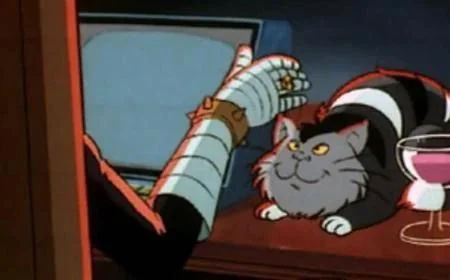
This difference is sociologically important. The cartoon villain operated in the shadows. Contemporary power operates in the showcase, converting attention into capital and controversy into strategy. And that forces us to accept a contradiction that we, as a society, handle poorly: we tend to want complete heroes or villains. If someone creates something extraordinary, we want them to be extraordinary in every way. If something about that person displeases us, the temptation arises to erase everything they have done. Reality rarely works that way. A person can have incredible ideas, or buy and scale them with enormous talent, and at the same time have terrible judgment in other areas. Musk remains a tremendous creative in the style of the bad guy from Inspector Gadget. The difference is that this villain shows his face, and so it falls to us to decide with discernment how much symbolic power we grant him.
What Will My Children See?
Returning to the car, the Roadster is astounding, and the question that remains for me is inevitable: what is next? If I, at 44, am seeing a drawing I made at nine materialize, what will my children see when they are my age? Perhaps their own drawings from today, with robots that converse or cities that move on their own, will be the everyday reality of 2060. At the rate we are going, it does not seem unreasonable to think that our great-grandchildren will test-drive cars on the Moon or Mars, and that they will see it with the same naturalness with which my children speak to an artificial intelligence today.
I feel fortunate to witness this historical moment, in which artificial intelligence and space engineering coincide with the nostalgia of a generation that grew up imagining exactly this. But fortune brings responsibility. It is up to those of us who grew up drawing the future to teach our children how to dream it without blindly surrendering their imagination to anyone, no matter how brilliant they may seem. The rocket car from 1991 already exists. What is not yet written is what kind of society will be driving it.