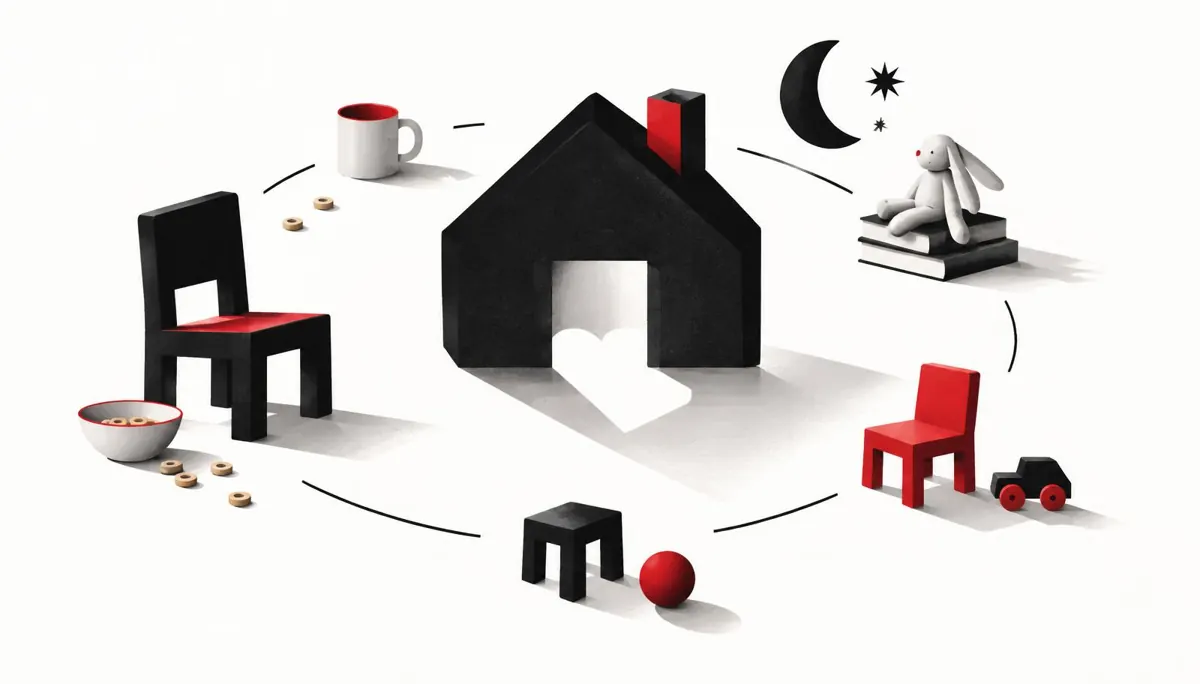
Nobody hands you a manual when you have kids. With the first, you wing it. With the second, you think you’ve got some experience. And with the third, you discover that every child comes with their own invisible manual that you have to figure out as you go. We’re up to three now: ages 8, 3, and 2. Yes, I know what you’re thinking. And yes: highly recommended! Hahaha.
Having three kids means living in a house where something is always happening. There’s noise, toys, running around, questions, arguments over things that won’t matter five minutes later, and moments of pure tenderness that show up when you least expect them. It’s intense, sure. But it’s also an incredible stage of life, and I’m increasingly certain that I want to enjoy it while it’s happening, not just look back on it later.
Because that might be one of the biggest things I’ve learned as a dad: kids grow up while you’re busy doing other things. And if you don’t make a conscious effort to stop, play, listen, and simply be with them, time keeps passing anyway.
The chaos has a schedule... more or less
Mornings at our house can look like a military operation, except nobody really knows the plan. Someone can’t find their other shoe, usually the same shoe that disappears every week. Someone else has decided they want pancakes when breakfast is already on the table. And our youngest may decide the day starts at 5:45 a.m. because, apparently, someone gave her complete authority over the entire family’s clock.
Nights are no different. Putting three kids to bed can turn into a diplomatic summit with three independent delegations, each with its own demands. One wants water. Another needs to go to the bathroom again. Someone wants one more story. Someone else suddenly remembers something incredibly important that happened six hours ago and needs to discuss it at that exact moment. By the time everything is finally quiet, Irka and I are often ready to fall asleep two minutes later.
But now I look at that chaos differently. I know it won’t last forever. A time will come when nobody asks me for another story, nobody needs me to carry them, and I’ll probably have to chase them down to get them to tell me about their day. So even when I’m exhausted, I try to remember that this stage is a privilege, too.
What matters most is having fun with them
To me, being present doesn’t just mean being physically in the same house. It means participating. Sitting on the floor to play, riding bikes, going out with them, playing video games with our oldest, coming up with whatever with the little ones, watching a movie together, taking them somewhere, or simply paying attention when they want to show me something that’s incredibly important to them, even if it seems insignificant to the rest of the world.
And I have to admit something: I love playing with them. I don’t just do it because I know it’s good for them. I do it because I have fun. I like hearing them laugh, watching them invent rules that change halfway through the game, and discovering how each of them thinks. Sometimes I’m Dad, sometimes I’m a teammate, other times I’m the monster chasing them all over the house, and quite often I end up being the character who loses because apparently that’s a fatherly duty, too.
I always want to be there. That doesn’t mean it’s possible to take part in absolutely everything or that you have to abandon your responsibilities. It means that, among all those responsibilities, spending time with them has to be a priority. If we wait until our calendars are completely clear to enjoy time with our kids, it probably won’t ever happen. We have to make the time, protect it, and make it part of everyday life.
Child development research has been emphasizing the importance of exactly these interactions for years. Harvard’s Center on the Developing Child uses the concept of serve and return to describe the back-and-forth exchanges between a child and an attentive adult: the child talks, points, asks questions, laughs, or seeks attention, and the adult responds. These everyday interactions help strengthen connections related to language, social skills, and emotional development.
What’s interesting is that we’re not necessarily talking about complicated or extraordinary activities. Often, it’s simply a matter of paying attention, responding, talking, and spending time together. For a child, five minutes when you’re genuinely present can mean much more than an hour when you’re physically nearby but mentally somewhere else.
We work from home, and that changes a lot
In our case, there’s another factor: Irka and I work remotely from home. Alterno operates on a fully digital, remote model, so our office is woven into our daily lives. We don’t have to head off to different places every morning or spend hours apart commuting. That gives us flexibility we value enormously because it lets us be close to our kids and organize our schedules in a way that would probably be much more complicated with a traditional office setup.
But working from home doesn’t mean we’re free all day, either. We still have meetings, calls, proposals, campaigns, clients, deadlines, and responsibilities. When the routine works, things flow pretty well. Each child is at school or daycare, we work from home, and during those hours we can generally focus. We wrap up a meeting, pick up the kids, handle whatever needs handling, and adjust the rest of the day around our family.
That’s when you understand the difference between working from home and having the kids at home while you try to work. They are two completely different experiences.
When school’s out, the real challenge begins
The real test of patience comes when that routine disappears. Christmas. Summer. Holidays. An illness. An unexpected school closure. A storm. A power outage. Something unforeseen that means all five of us are suddenly at home while Irka and I still have exactly the same meetings, deadlines, and responsibilities we had the day before.
That’s when the famous “work-family balance” stops sounding like a nice LinkedIn phrase and becomes a hands-on exercise in survival.
You might be on a video call trying to discuss a campaign while someone in the background asks for a snack. Irka might be helping a client while another child needs help with something so urgent that, from their perspective, it can’t possibly wait thirty seconds. Suddenly you’re answering an email with one hand while using the other to look for a toy that has apparently vanished forever under the couch.
And if we add the realities of living in Puerto Rico, where a power outage or some other interruption can change your work plans in an instant, the logistics reach a whole new level. You have to reschedule meetings, figure out an internet connection, shift things around, and keep a household running with three kids who have no particular interest in their parents’ deadlines.
That really tests your patience. It also tests your ability to improvise, split responsibilities, and accept that some days simply won’t go exactly as planned.
Flexibility doesn’t mean perfection
From the outside, working remotely can sometimes look like the perfect solution for a family. And for us, it absolutely has a lot of advantages. But flexibility doesn’t eliminate the challenge of parenting while working. What it does is give us more tools to respond when life changes the plan.
Some days, Irka takes a meeting while I stay with the kids. Then we switch. Sometimes we reschedule a call, get ahead on work at night, or use a nap to finish something that requires concentration. And some days, we simply have to accept that we’ll get less done because our kids need us more.
That’s part of balance, too. Balance doesn’t mean every day has exactly the same amount of work, family, rest, and fun. To me, it means having enough flexibility to recognize what needs more attention at any given moment.
Some days are very productive. On others, the most important thing was caring for a sick child. Neither day was necessarily wasted.
Three strangers who became siblings
One of the most remarkable things about having several kids is watching the relationship between them take shape. These three human beings arrived at our house at different times, not knowing one another, and little by little they’ve become a small team with their own language, their own codes, and, naturally, their own conflicts.
Sometimes they’re full-on partners in crime. One has an idea they clearly shouldn’t follow through on, and the other two immediately understand that their duty is to help. Other times, they become sworn enemies over ownership of a toy that had been abandoned for three weeks and has suddenly become the most important object on the planet.
But then you see them taking care of one another. The oldest helping the little ones, one looking for another, sharing something without being asked, or all three laughing at something silly that only they understand. That’s when you realize they’re also building a relationship that, with any luck, will stay with them long after Irka and I stop being the center of their lives.
I love watching that relationship grow. Even the little arguments are part of learning to negotiate, share, stand their ground, apologize, and go back to playing together five minutes later. Sometimes I think we adults could learn a lot from how quickly they move past conflicts.
The good fortune of having a little girl
After two boys, our little girl arrived. Welcoming her was a blessing we probably didn’t know we were missing until she showed up. She brought another personality, another energy, and a completely new dynamic to the house. More laughter, more tenderness, and, of course, a strong personality all her own.
The house changed with her. The pace changed, certain routines changed, and even the relationship between her brothers changed. Now we simply can’t imagine our family any other way. That’s one of the funny things about kids: before they arrive, you can picture life without them perfectly; once you know them, it’s impossible to understand how that earlier life even existed.
Shaping people, not just raising children
Of all the responsibilities of being a parent, this might be the one that leaves me most in awe: we’re shaping people. These little kids who need help finding a shoe today will one day make decisions on their own, choose friends, fall in love, work, make mistakes, have opinions of their own, and build a life that no longer depends on us.
Our job can’t be to control every step of that life. To me, it’s more about trying to give them a foundation. Respect, empathy, a sense of humor, responsibility, curiosity, the confidence to ask questions, and the certainty that they can always come back to us when they need guidance.
And along the way, I also want to teach them something by example: life can’t be all responsibilities. You have to enjoy it. You have to play, laugh, travel when you can, celebrate the little things, break out of your routine, and find time for the people you love.
That message matters to me because kids will probably learn much more from how they see us live than from the speeches we give them. If I want them to value their family, their friendships, and their time someday, I also have to show them now that I value my time with them.
Playing is a way to connect, too
Sometimes we adults see play as something kids do while we do the “important” things. But for them, playing is an essential part of how they discover the world, develop skills, and build relationships. The American Academy of Pediatrics emphasizes that play can support skills related to planning, organization, language, emotional regulation, social interaction, and stress management.
UNICEF also highlights how playing together strengthens the bond between children and caregivers. When we share fun moments with them, we’re not just keeping them entertained. We’re entering their world, learning how they think, and creating moments of connection.
That’s essential to me. I want to know their worlds. I want to know what they like, what games they play, what makes them laugh, and what worries them. With our oldest, I can play a video game, ride bikes, or talk about something he saw online. With the little ones, it might mean playing with toy cars, running around the house, or repeating an activity twenty times because they find it incredibly entertaining and I already know it by heart.
The activity itself doesn’t matter all that much. What matters is that, during that time, they know I’m there with them.
The luxury of being available
Our remote work setup is one of the things we’re most grateful for in the life we’ve built. Not because working from home is easier, but because it gives us something we value enormously: the ability to rearrange our time when our family needs it.
Being able to pick up the kids, attend a school event, stay with one of them when they’re sick, or simply be present for important moments is a privilege. That flexibility often means making up for it later, working into the evening, or completely rearranging the day. But having the option makes a huge difference in our quality of life as a family.
Over the years, I’ve come to understand that owning your time doesn’t mean having the day off. It means having a little more say in where you want to be when it really matters. And for us, that place is often with them.
Alterno has been a huge part of our lives, and we still have professional goals, projects, and plenty of things we want to build. But the kids put all of that into perspective. The business can grow, change, and evolve. This stage of their lives, on the other hand, has an expiration date, even if we don’t know what it is yet.
Being present takes intention, too
Sometimes we talk about being present as though it happens automatically because we love our kids. But the truth is that life is constantly competing for our attention. Work, phones, meetings, to-do lists, exhaustion, and worries can fill any space we leave open.
That’s why I think being present is something we build, too. We have to decide to turn something off, put something else aside, look up from the computer, and say: let’s play. Not always for hours. Not always doing something spectacular. Just building the habit of letting our kids know there are moments when our attention belongs to them.
Harvard notes that responsive, attentive relationships with caring adults help build a strong foundation for children’s development. To me, outside the scientific language, that translates into something very simple: respond when they reach out. Listen when they talk. Laugh when they do something funny. Comfort them when something hurts. Celebrate when they accomplish something. And be available as often as life allows.
What I really want to remember
I don’t know what our kids will remember about these years. They probably won’t remember many of the things that feel huge to us today. I don’t think they’ll remember whether I submitted an important proposal one week or whether a campaign went exactly as planned. They might not even remember many of the places we took them when they were little.
But I hope they remember a feeling. That Mom and Dad were there. That we played with them. That we laughed. That they could come to us. That home was a safe place. That even with work, responsibilities, meetings, and complicated days, we always tried to make room to have fun together.
And that’s how I want to remember them, too. Running around the house while I try to finish a call, making up games while Irka answers an email, fighting over toys, asking for another story, laughing way too loudly, wanting to show me something for the fifth time, and calling me over to play with them.
Because I know that one day the house will probably be much quieter. And I suspect that when that day comes, I’m going to miss this noise terribly.
Maybe we’re not millionaires in money yet, but every day I’m more convinced that we’re millionaires in time together, laughter, hugs, and love. And that’s a fortune we need to enjoy while it’s right here in front of us.
The verdict after eight years of fieldwork: three kids, highly recommended! Hahaha. A lot of work, a lot of lost sleep, plenty of improvising, a few interrupted meetings, a whole lot of noise, and an amount of love I never could have explained before experiencing it.
Sources and related reading
Center on the Developing Child at Harvard University. Its work on serve and return explains how responsive, back-and-forth interactions between children and their caregivers contribute to the development of connections related to communication, social skills, and emotional well-being. View resource.
American Academy of Pediatrics / HealthyChildren.org. “The Power of Play: How Fun and Games Help Children Thrive”. The AAP highlights the role of play in skills such as planning, organization, language, social interaction, emotional regulation, and stress management, as well as the importance of parents and children playing together. Read article.
UNICEF Parenting. “How play strengthens your child's mental health”. UNICEF emphasizes that sharing playtime can strengthen the bond between children and caregivers and offer opportunities for connection, learning, and emotional well-being. Read article.
UNICEF Parenting. “5 activities to develop a connection with your child”. UNICEF recommends looking for opportunities to spend quality time, play, and have fun together as part of building the bond between parents and children. View resource.
Keep reading: building together with my wife and Fortnite at home, with supervision.