How curiosity, nearly twenty years of digital experience and a new generation of artificial intelligence let me turn ideas into real technology products.
I'm not a programmer
I can read code, recognize structures, make basic tweaks and talk with developers without feeling like we speak different languages. But if you sit me in front of a blank screen and ask me to build an app from scratch, I can't. And I have no problem admitting it.
What's interesting is that I've spent most of my life trying to understand how the Internet works. Long before I knew I'd end up working in digital advertising, web development and technology, I was already experimenting with what was being born before my eyes, even before the dot-com bubble.
Learning the ecosystem before knowing why
I started out playing with Microsoft FrontPage. I had no business project and wasn't thinking about a tech career; I just wanted to understand how those pages worked. At 16 I built my own website in Macromedia Flash. It was slow, heavy and probably pretty ugly. Today it would break almost every rule of UX, accessibility and performance. But it worked. And above all, I learned.
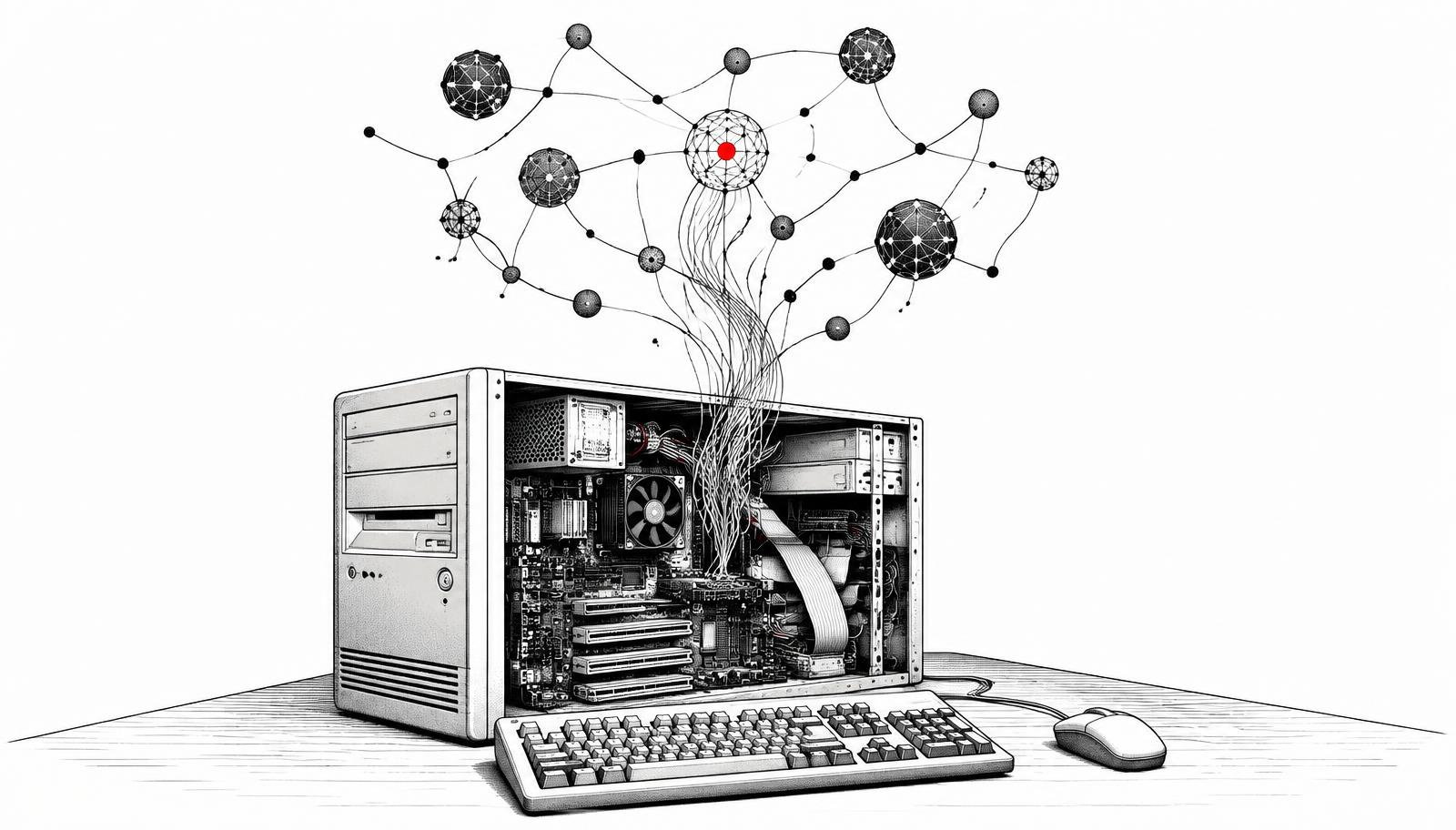
There was a time when my bedroom looked like a makeshift nerd headquarters: computers open on the table, parts I assembled and took apart, friends burning CDs in Nero Burning ROM while we waited for a new MP3 to finish downloading from LimeWire. I wrote about that era in the day I connected to the Internet for the first time.
Back then I didn't see the Internet as my future. I was drawn to Sociology and pictured myself in Industrial-Organizational Psychology. The Internet, however, had other plans for me.
Nearly twenty years inside the digital world
That curiosity became a profession. I've spent almost two decades inside the digital ecosystem, watching platforms appear, grow, transform and disappear. I built websites when companies still had to be convinced they needed one. I watched social media go from conversation spaces to some of the most sophisticated advertising systems in history.
Along the way, my work was never limited to one discipline: advertising, strategy, content, web development, SEO, user experience, analytics and automation began to overlap. That forces you to see differently. When I look at a platform, I don't just see the screen; I think about what happens behind it:
- What data does it need to store, and who does it belong to?
- How does a user sign in, and what happens if they lose their password?
- What does an admin see that a customer shouldn't?
- How does it charge, and what happens if a payment fails?
- What happens on mobile, with a hundred users or a hundred thousand?
- What does it take to launch publicly?
Those questions don't require me to write every line of code. They require something else: understanding the whole system well enough to direct how it gets built.
Then came the new frontier
Over the past few months I decided to do something like what I did at 16: dive in, quietly. Learn, test, break things and start over. Long nights and short mornings. This time the subject wasn't FrontPage or an open PC, but the new generation of artificial intelligence.
I quickly understood that asking ChatGPT to summarize a document is one thing, and watching different agents work together is something else entirely: researching a problem, structuring a solution, writing code, designing, checking quality and validating full launch plans. Once I grasped that second part, what I saw was far bigger than I had imagined. And I couldn't stop.
AI didn't turn me into a programmer
This matters. A few months with AI tools don't replace years of training as a good developer; claiming otherwise would be absurd. What did happen was different: AI dramatically shortened the distance between someone who deeply understands a problem and the ability to turn that understanding into a working solution.
For years I could picture products, define their logic and describe their processes, but I depended entirely on others to build them. Now I can explore, prototype, validate, document, question and iterate while the systems produce the code and I focus my energy on defining what that code should do. My strength was never writing hundreds of lines of code. My strength has always been connecting the dots.
The value is still in knowing what to build
AI can produce code, but someone has to decide what's worth building. There has to be a problem, an audience, a business model, a flow, an identity and a standard for knowing when something is ready for the public.
That's why these projects didn't start with random prompts. They started with research and market, competitor, product and audience analysis; with architecture, design, branding, processes, testing, security, quality control and launch planning. And yes, a lot of prompt engineering. But the prompt was never the product.
As a sociologist, I see it this way: when a tool makes production cheap, we tend to confuse producing with creating. Being able to generate something easily doesn't make it easy to build a good product. Those remain two very different things, and what separates them is human knowledge of the context.
Alterno Group and a new chapter
After months of studying and experimenting, I felt ready to turn ideas, some of them years in the making, into real products. And we did. Today we're beginning to present a family of digital and technology businesses under our parent company, Alterno Group.
Some will serve consumers, others businesses, and others very specific industry needs. Meanwhile, Alterno Agency remains our advertising, digital marketing, technology and development operation for clients. Alterno was born digital in 2009; what we're building now doesn't abandon that story, it expands it. We no longer only build for others: we're creating our own technology assets too.
What's next
The coming months will bring official launches, new developments and announcements I can't share yet. We're also building relationships with AI and technology platforms that could become important development and business partners for Alterno's future.
I'm very excited about what's left of 2026, and even more about 2027. I feel something I hadn't felt this strongly in a long time: the same curiosity I had in front of that open computer in my bedroom. The difference is that now I have nearly two decades of experience to make sense of what I'm seeing.
Maybe it was never just about learning to code
For a long time we tied the ability to build technology to the ability to write code. Code is still essential. But AI is widening who gets to take part in creating technology: a designer can go further, a strategist can prototype, an entrepreneur can validate an idea and a specialist can build the tool for a problem they know better than anyone.
That doesn't eliminate specialization; it makes it more powerful. When technical barriers drop, knowing the problem matters even more. Maybe that's why my own story is starting to make sense now: FrontPage, Flash, open computers, digital advertising, websites, analytics. I spent decades preparing for this stage without knowing I was preparing for it.
Thanks for reading. If you want to understand how to apply these technologies to your business or operation, we can work together directly through my consulting or through Alterno Agency.