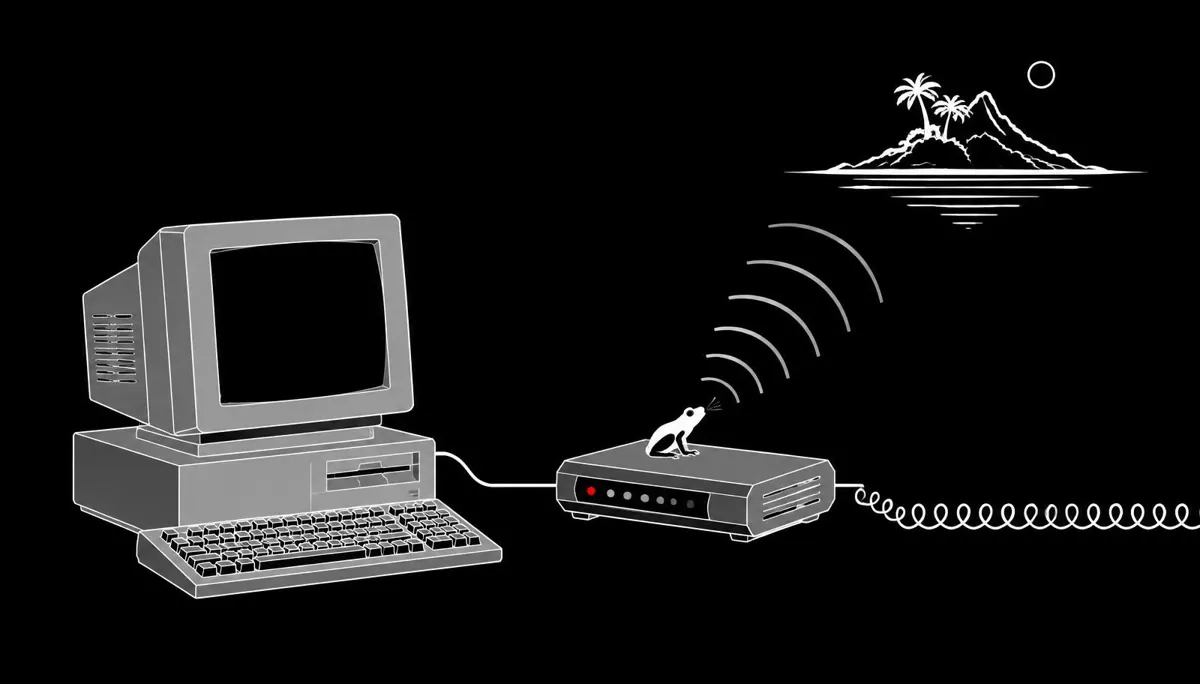
It was 1993. I was at my friend Javier''s house, in front of a computer that today would look like a museum piece. He dialed a number, and the modem began that concert anyone from my generation recognizes with their eyes closed: beeps, screeches, static… and suddenly, silence. We were connected. Wow.
I can''t quite explain what I felt. It was like opening a door in the bedroom wall and discovering a whole planet behind it. Texts from universities in other countries, people chatting at that very moment from places I only knew on a map. That afternoon our lives changed.
Puerto Rico before the "www"
To understand the magic you have to understand the context. In the early 90s the internet was mostly academic. In Puerto Rico, the University of Puerto Rico was already connected to academic networks, and the more adventurous lived on BBSs (bulletin board systems): computers you dialed by phone to leave messages, download files and play games. Services like CompuServe, Prodigy and America Online had access numbers in San Juan [1].
Everything ran through the house phone line, so going online had a social cost: nobody could call while you were surfing. More than one family argument started with "get off the phone, I''m expecting a call!".
Enter the Puerto Rican providers
By the middle of the decade local providers were born. Caribe.Net, founded in 1994, is recognized as Puerto Rico''s first commercial internet provider [2]. Soon after, Datacom Caribe launched Coquí Net (coqui.net), a name many Puerto Ricans associate with our first email accounts [1][3]. Its network was officially registered in 1997 [3], and the coquinet.com portal became a window for the diaspora to read the island''s newspapers and listen to its radio from anywhere in the world; an MIT student even picked it as his favorite website in 1997 [4].
That detail moves me: from the start, the Puerto Rican internet was a bridge. It connected those here with those over there.
From curiosity to career
That afternoon with Javier wasn''t just an anecdote; it was a compass. I studied Sociology because I''ve always been fascinated by how people behave in groups, and the internet was the biggest social experiment I had ever seen. Then came chats, the first hand-coded HTML web pages, banners, search engines, social media, mobile and now artificial intelligence. In 2009 I founded Alterno Agency, and more than three decades after that first modem screech I''m still here, working in digital every day.
What I learned in 30 years online
- Technology changes; human needs don''t. We want to talk, learn and belong. From BBS to TikTok, it''s the same thing in higher resolution.
- Curiosity is the best investment. Nobody taught me a digital career because it didn''t exist; we learned it by exploring.
- Friends open doors. Literally: without Javier and his modem, who knows what I''d be doing today.
Thank you, Javier
Today my kids talk to voice assistants and watch HD videos without knowing what it''s like to wait five minutes for a photo to load. I love it. But now and then I tell them about the screeching modem and they look at me like I''m describing the Middle Ages. And in a way I am: it was the internet''s middle ages, and we were lucky to live it from the very beginning.
That modem sound was, without my knowing it, the anthem of my career.
References
- Ortiz Laureano, Z., et al. (1990s). "Who is providing Internet services in Puerto Rico?", Puerto Rico FAQ (soc.culture.puerto-rico). Mentions Caribbean Internet Service, Datacom Caribe (coqui.net) and services like AOL and CompuServe.
- Wikipedia. "Caribe.Net". Founded in 1994 as Puerto Rico's first internet provider.
- ARIN WHOIS. AS10396 COQUI-NET – Datacom Caribe, Inc., San Juan. Organization registered in 1995; network registered in 1997.
- MIT, Intro to Media Studies BBS (1997). "Favorite web site": coquinet.com as a window to Puerto Rico's press and radio.