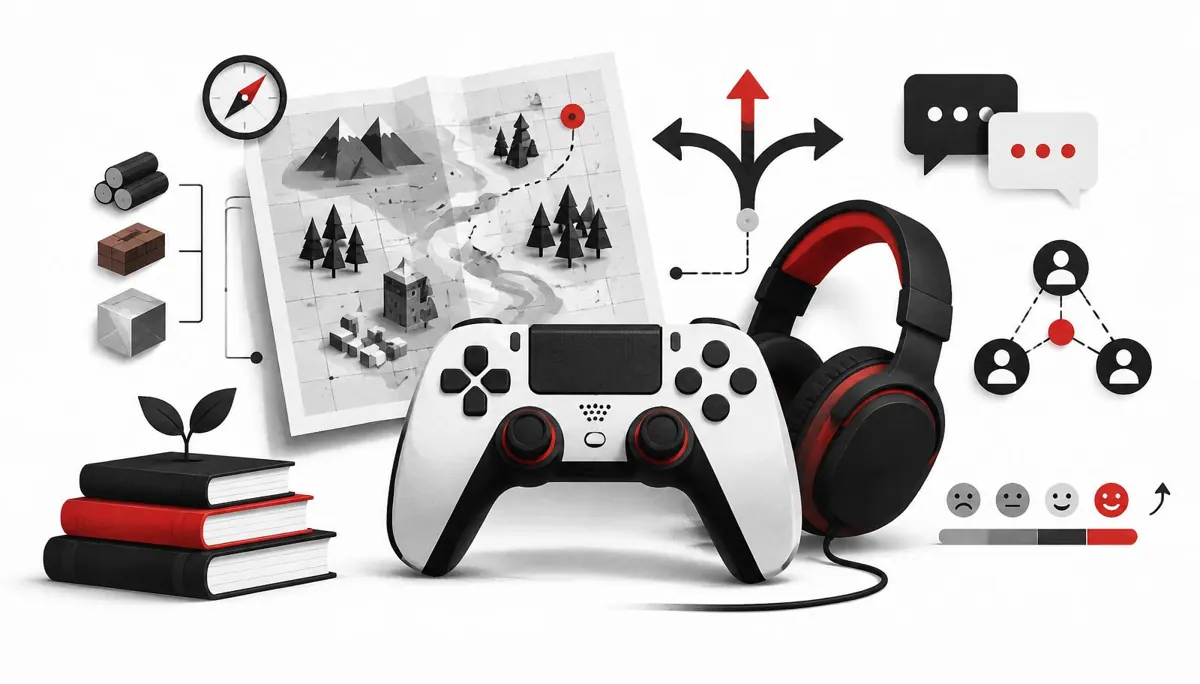
I know what you’re thinking. “You let an 8-year-old play Fortnite?” Yes. With supervision, with schedules, with clear rules, and with me sitting right next to him many times (or inside the match, to be honest). And I don't do it out of laziness or to just get him off my back: I do it because, as a lifelong gamer and tech lover, I see something that many people don't.
I see a training ground.
What nobody sees behind the screen
When most adults look at a child playing, they see a kid glued to a screen shooting at things. When I look at my son playing, I see an 8-year-old making dozens of decisions per minute: where to land, what resources to gather, when to build, when to fight and — the hardest one for a child — when NOT to fight and retreat.
In psychology, that has a name: executive functions. And science is starting to back up what we gamers have known for years. A study of nearly 2,000 children aged 8 to 9, funded by the National Institutes of Health (NIH) and published in JAMA Network Open, found that children who played video games performed better on impulse control and working memory tests than those who never played [1][2]. It's not just a dad excuse: it's evidence.
The skills it actually develops (that no one applauds)
Let me list what I've seen with my own eyes, in my own living room:
1. Planning and strategic thinking
Fortnite isn't just running and gunning. It's deciding on a route before the storm closes, managing materials, and anticipating what the other team will do. It's planning under pressure and in real-time. My son thinks three moves ahead like it's chess with pretty graphics.
2. Problem-solving
Every match is a new problem with limited resources. Ran out of materials? Improvise. Got surrounded? Find the exit. Failing is part of the process: you lose, you analyze what went wrong, and you try again. That, folks, is resilience. Studies confirm it: facing constant defeats within a game trains frustration tolerance and perseverance [6].
3. Fine and gross motor skills
Hand-eye coordination, reaction speed, millimeter precision with the controller. Action video games stimulate processing speed and cognitive flexibility [6], and there are meta-analyses documenting improvements in motor skills in children through video game-based interventions [7].
4. Teamwork, communication, and interpersonal skills
This is where people get it most wrong. “Video games are isolating.” Oh, really? My son plays in a squad with school friends and cousins who live far away. They coordinate via voice, assign roles, warn each other of dangers, celebrate victories together, and comfort each other in defeat. A study published in Computers in Human Behavior — known as “the Fortnite social paradox” — found that playing in cooperative mode was associated with HIGHER prosocial behavior in children [3]. Multiplayer worlds increase opportunities for collaboration, social interaction, and friendship. UNICEF, which isn't exactly a video game store, recommends that parents play WITH their children and let them be the experts who teach you their world [4].
And let's be specific, because there’s hidden gold here. The Fortnite squad is pure teamwork: four people who aren't seeing each other's faces have to communicate clearly, delegate roles, signal danger in real-time, listen to a teammate asking for help, and adjust the plan when the play changes. My son learns to say “on the right, two enemies” instead of “aaah, there, there!”. That precision — naming, orienting, coordinating — is the same he’ll later use in a school group project, on a basketball team, and one day in a boardroom. Research backs this up: collaboration in virtual worlds strengthens communication and interpersonal skills [3], and online play spaces serve as stages where children practice empathy, belonging, and cooperation [6].
5. Leadership
Someone has to decide where the squad is going. Someone has to calm down the friend who got frustrated. I’ve seen my 8-year-old do both. That’s leadership in digital diapers.
6. Resource management
Wood, stone, metal, ammo, shields, time. Everything is finite and everything must be managed. If that’s not a lesson in economics and priorities, I don’t know what is.
7. Natural interaction with technology
My son navigates interfaces, configures settings, understands latency, servers, and updates. He is growing up speaking the language of the 21st century with native fluency. For a dad who founded a digital agency, that’s no small thing: it’s future literacy.
8. Emotional regulation and management
Losing in Fortnite hurts (ask me about it). Learning to lose, breathe, and jump back in without a tantrum is a massive emotional skill. Research points out that moderate gaming works as a healthy escape and “mental vacation,” reducing stress and improving mood [6].
9. English and Spanish, two languages for the price of one
Puerto Rican fact: the game speaks English. The menus, the commands, the voice chat, the weapon names, the meme culture. Without realizing it, my son is reading, listening to, and speaking English in a context that actually matters to him — and the language you learn in a real context, not on a school whiteboard, is the one that sticks. Between matches, he switches from “reload, let's go” with his classmates to “¡Ay, mami, ven a ver esto!” with his mom: live code-switching, like any self-respecting Puerto Rican. And there's reading involved too: there is evidence that an action video game designed with cognitive training improved the reading skills of the children who played it [5]. Two languages, zero extra classes. Good deal.
The house rules (because yes, there are rules)
For the record: this isn't an open bar. At home, it works like this:
- Clear schedules. Gaming is an earned privilege, not a right. Homework first, reading first, outdoors first.
- Real supervision. We know who he plays with, the chat is limited to known friends, and the game happens in common areas of the house, not locked in a room.
- Locked purchases. No saved cards or impulsive skin buying. Every V-Buck is a conversation.
- We play together. The best supervision is sharing the game. Plus, that way he beats me and laughs at his dad, which is apparently the greatest pleasure of his life.
The keyword: moderation
All serious research says the same thing: the benefits appear with moderate and supervised play. The same NIH study warns that children who played three or more hours a day also showed more attention problems [1]. In other words: the dose makes the poison, just like everything else in life. One well-spent, shared hour is not the same as six hours alone.
In summary
I let my son play Fortnite because I don't see a waste of time: I see a child training in planning, communication, teamwork, leadership, technology, and English, all while laughing with his friends. My job as a dad isn't to ban him from the digital world he’s going to live in; it’s to teach him to navigate it with good judgment.
And yes, I also teach him to ride a bike, how to lose at dominoes against his grandpa, and that the screen turns off when Mom says it turns off. Balance, just like in any good match.
Moderate gaming is not the enemy. Disconnected parents are.
References
- National Institutes of Health (NIH). “Video gaming may be associated with better cognitive performance in children” (2022). https://www.nih.gov/news-events/news-releases/video-gaming-may-be-associated-better-cognitive-performance-children
- Chaarani, B. et al. “Association of Video Gaming With Cognitive Performance Among Children”. JAMA Network Open (2022). https://jamanetwork.com/journals/jamanetworkopen/fullarticle/2797596
- Shoshani, A. and Krauskopf, M. “The Fortnite social paradox: The effects of violent-cooperative multi-player video games on children’s basic psychological needs and prosocial behavior”. Computers in Human Behavior, Vol. 116 (2021). https://www.sciencedirect.com/science/article/abs/pii/S0747563220303885
- UNICEF. “Video games in childhood and adolescence: a guide for parents”. https://www.unicef.org/parenting/es/cuidado-infantil/video-juegos-en-infancia-y-adolescencia
- Pasqualotto, A. et al. “Enhancing reading skills through a video game mixing action mechanics and cognitive training”. Nature Human Behaviour (2022). https://www.nature.com/articles/s41562-021-01254-x
- Reference document provided by the author: “Moderate gaming provides important psychological and social benefits” (compilation of NIH findings on emotional regulation, resilience, executive functions, and social benefits of gaming).
- Gao, M. et al. “Effects of video game-based interventions on executive functions and motor skills in children and adolescents with neurodevelopmental disorders: a systematic review and meta-analysis”. Frontiers in Rehabilitation Sciences (2026). https://doi.org/10.3389/fresc.2026.1742526