I’ve spent more than two decades working in digital media, and in that time I’ve watched platforms that seemed destined to last forever come along, change completely, and, in some cases, disappear. MySpace dominated an era. Vine created a culture of its own before shutting down. Google+ arrived with the backing of one of the world’s biggest tech companies, and it didn’t survive either. Even the platforms still leading the way today have changed their algorithms, formats, and priorities so many times that they’re practically different products from the ones we knew a few years ago.
That’s why there’s one idea I keep coming back to after all these years: if your entire digital presence depends on a platform you don’t control, you also depend on that platform’s decisions.
This isn’t just how those of us in digital advertising see it. The platforms themselves explain how they decide what content to show. Meta, for example, documents how the Instagram feed uses ranking systems that analyze different signals and assign posts a score based on how likely someone is to interact with them. In other words, publishing content doesn’t automatically mean all your followers will see it. The platform decides, through its own systems, which content is most likely to appear in front of each user.
YouTube explains something similar. Its recommendation system uses signals like watch history, searches, subscriptions, clicks, watch time, likes, and other interactions to decide which videos to recommend. The company itself has noted that recommendations drive a significant share of YouTube views—even more than subscriptions or searches within the platform.
That isn’t necessarily a bad thing. It’s exactly what allows these platforms to organize enormous amounts of content and offer personalized experiences. But it does make one thing very clear for any business or professional: distribution on a social network depends on rules and systems that belong to another company.
Social media matters, but it shouldn’t be your entire digital presence
When someone builds their entire personal brand or a business’s whole digital ecosystem exclusively around social media, they’re building in a space managed by another company. That company can change the algorithm, reduce organic reach, favor new formats, remove features, change its business policies, or completely reshape how it distributes content.
And it probably will. Not because there’s anything particularly wrong with that, but because platforms constantly evolve around their own business models, technologies, and goals.
That’s why I don’t think the answer is to abandon social media. Quite the opposite. These are incredible tools for finding audiences, distributing content, building community, starting conversations, and quickly reaching thousands of people. We use them every day at Alterno, and they’re a fundamental part of practically any modern digital strategy.
The mistake is making them the only place your brand exists.
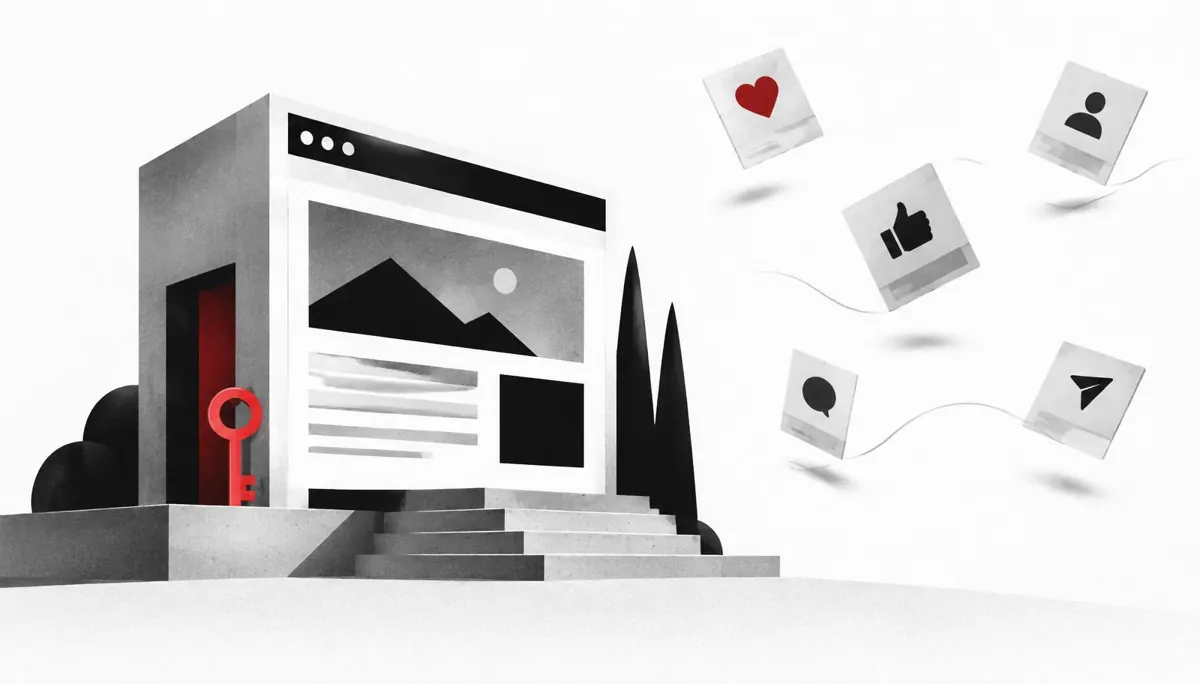
Social media distributes. Your website builds.
I like to look at it simply: social media draws people in; your website converts and builds lasting value. Social media can get your message to people. Your website is where that message can become something more lasting.
It’s where you can explain who you are, introduce your services, publish your ideas, showcase your work, organize your content, capture a lead, sell a product, build a knowledge base, or develop a more direct relationship with someone interested in what you do.
You also have much more control over the experience. You decide how the information is organized, what appears first, how navigation works, what action you want someone to take, which technologies you use, how you present your projects, and what content deserves to stay visible for years.
That doesn’t mean a website is independent of third parties. You need a hosting provider, a domain registrar, possibly a CMS, and you’ll probably depend to some extent on Google and other search engines for traffic. But there’s an important difference: you can switch providers, move to another server, change your CMS, or completely redesign the experience without necessarily losing the digital identity you’ve built.
Your domain is an important part of that independence
To me, there’s something especially valuable about having your own domain. ICANN, the organization that coordinates much of the global domain name system, defines the registrant as the person or entity that holds the rights associated with a registered domain name, subject, of course, to the registration and renewal terms.
That matters because a domain can stay with a brand for many years, even as everything around it changes. You can change your hosting, developer, technology, or platform and keep the same digital address as a point of reference.
That’s why I prefer to say that a domain isn’t outright property in the same sense as a house or a piece of land, but it does represent a digital identity over which the registrant has much more control than over a profile on a social network.
Your username on a platform lives inside that platform. Your domain can become the place from which you connect all the others.
Your own content can keep working after you publish it
This is another reason I value websites and blogs so much. A social media post can have a very intense life for a few hours or days, then get buried under hundreds of new posts. An article on your website works differently.
Google explains that its systems continuously crawl the web, analyze pages, and may add them to its index to show them later when someone makes a relevant search. That means useful content published today could potentially be discovered months or years down the road.
Google doesn’t guarantee that a page will rank or stay in a particular position, either. Its algorithms change too. But there’s a fundamental difference: the article remains published under your domain. You can update it, expand it, reorganize it, link to it from new pages, and keep building around it.
Google’s own documentation recommends creating helpful, reliable, original, people-first content. It also explains that promoting that content through social media can help users and search engines discover it. To me, that perfectly sums up how these two worlds should work together: publish content on your own digital asset and use other channels to distribute it.
Your content builds a library over time
Some ideas deserve to last longer than a post in a feed. An article, a reflection, a case study, a research project, or an in-depth explanation can keep providing value long after it’s published.
Over the years, that growing collection of content also starts to tell the story of a person or a company. Someone who discovers your website today can read what you wrote three years ago, understand how your thinking has evolved, learn about earlier projects, and get a much deeper sense of your journey.
That’s especially important for a personal brand. A social network mostly shows what you’re posting now. A thoughtfully built website can show who you are, what you know, what you’ve done, and how you’ve evolved.
At Alterno, we see it as an ecosystem
At Alterno, we work across social media, web development, digital campaigns, content, strategy, and technology. It’s precisely because we work in all those areas that we can see the difference between thinking in isolated channels and thinking in terms of a complete digital ecosystem.
A good website shouldn’t just be a digital brochure you publish and forget about for five years. It can become the operations hub for a digital strategy: receiving campaign traffic, organizing information, capturing leads, publishing content, integrating tools, measuring behavior, and connecting different marketing initiatives.
Instagram can bring people into that ecosystem. LinkedIn can bring people. Google can bring people. YouTube can bring people. An email can bring people. A paid campaign can do it. Even a QR code on a printed piece can lead someone there.
The website serves as the central point where all those paths can meet.
It’s not about websites versus social media
Sometimes this conversation is framed as if you have to pick a side. To me, that debate doesn’t make much sense. A healthy digital strategy uses each channel for what it does best.
Social media is incredible for reach, community, interaction, and distribution. A website offers greater control, depth, searchability, conversion, and staying power. Email can help you maintain a more direct relationship with people who’ve chosen to hear from you. Paid media expands your reach. Content connects all those pieces.
When everything works together, no single platform has to carry the full weight of the brand.
Start with something simple
If you’re building a personal brand or a business, you don’t need to start with a huge website, either. Your own domain, a clear page explaining who you are and what you do, an easy way to contact you, and useful content can be enough to get started.
You can grow from there. You can add articles, case studies, tools, forms, services, automations, e-commerce, or any other functionality that makes sense for your project. The important thing is to start building a digital space over which you have more control.
After more than twenty years of watching the internet change, this is probably one of the recommendations I’ve made most consistently: use the platforms, but don’t build your entire identity inside a single one.
Post on Instagram. Participate on LinkedIn. Make videos for YouTube or TikTok. Make the most of each channel as long as it makes sense for your audience. But try to make sure all those paths also lead to a place where you can tell your full story, organize your knowledge, and turn attention into a more lasting relationship.
Because your website doesn’t replace your social media. It complements it. And within a complete digital strategy, it can carry just as much weight as any of those platforms—or even more.
Sources and related reading
Meta. “Instagram Feed Ranking System Card”. Meta explains how the Instagram feed gathers eligible posts, uses information about content and interactions, and generates scores to determine which posts to show each user. View documentation.
YouTube. “On YouTube's recommendation system”. YouTube explains how its recommendation systems use different signals to select and rank content, and highlights the role recommendations play in overall video viewing on the platform. Read post.
Google Search Central. “In-depth guide to how Google Search works”. Google explains the crawling, indexing, and search result serving stages that allow website pages to be discovered through searches. View documentation.
Google Search Central. “Search Engine Optimization (SEO) Starter Guide”. Google explains how search engines discover web content and recommends creating helpful, reliable, people-first content, as well as using channels like social media to promote it. View guide.
ICANN. “Information for Domain Name Registrants”. ICANN explains the rights and responsibilities of people and organizations that register and manage domain names. View information.
Related: the power of the written word in the video era. Want to know where your digital presence stands today? Try the free Digital Marketing Audit.